
Noted environmentalist R K Pachauri said the Himalayan glaciers are melting at a "very rapid speed", but did not refer to his earlier assertion that the glaciers could disappear by 2035, for which he had come under sharp attack from the government and others.
Accumulation of atmospheric brown clouds caused by the buildup of greenhouse gases is significantly contributing to the melting of Himalayan glaciers.

Slamming a UN climate body for predicting that most of the Himalayan glaciers will melt by 2035, the government on Monday said such forecasts were alarmist and sans scientific basis.
India and China are in talks to monitor the melting of glaciers in the Himalayas, a border region crucial to both countries' water supplies, Minister for Environment Jairam Ramesh has said. "We are talking to the Chinese about monitoring the Himalayan glaciers," Ramesh said. However, he cautioned that India would not allow Chinese scientists "to climb all over India's glaciers", but sought a collaborative research programme.
He said the melting glaciers could cause a rise in sea levels which could collapse Greenland and Antarctic ice-sheets. This in turn, he said, could have a disastrous effect on countries like Mauritius and Bangladesh.

It has noted that melting glaciers due to any impact of climate change will not only severely affect the flow in Himalayan river system but will also give rise to natural disasters.

A scientist from the Wadia Institute of Himalayan Geology highlights how climate change, including glacial retreat, shifting precipitation patterns, and rising nighttime temperatures, is exacerbating the risk of flash floods and landslides in the Himalayas, as seen in recent disasters in Nepal and Uttarakhand.
Prime Minister Dr Manmohan Singh on Thursday announced that all out efforts would be made to protect the Himalayan glaciers.
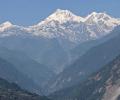
Melting of Himalayan glaciers has doubled since the start of the 21st century due to rising temperatures, losing over a vertical foot and half of ice each year and potentially threatening water supply for hundreds of millions of people in countries, including India, according to a study published in 2019.
The glaciers provide a lifeline for billions of people by feeding the major rivers in the region, according to the United Nations Environment Programme.

'Himalayan glaciers are expected to become smaller, and small glaciers will have disappeared, but by no means will all glaciers have melted by the end of the 21st century,' glaciologist Markus Stoffel tells Rashme Sehgal.


A recent study by scientists indicates that the Hindu Kush-Himalaya region is experiencing increased frequency and intensity of extreme weather events due to climate change, including rapid glacial melting and changing rainfall patterns. However, the research also cautions against solely blaming climate change, highlighting that human factors like population growth, commercial activities, and non-enforcement of regulations contribute significantly to the vulnerability and impact of these disasters. The study points out that many devastating floods originate from small glaciers and rain-fed streams, exacerbated by encroachment on unstable slopes and floodplains.
A number of perennial Himalayan streams could turn seasonal as glaciers are retreating at a faster rate than some 50 years ago leading to water scarcity in the plains during summer months.

A senior Geological Survey of India official warns that the Himalayas are vulnerable to cascading disasters, where one high-altitude event can trigger a chain of destructive events downstream, as evidenced by Nepal's recent floods. He stresses the need for integrated monitoring using satellite data and ground investigations to identify high-risk areas and improve preparedness in the Indian Himalayas.

Devastating flash floods in Nepal's Bhote Koshi River, triggered by a glacier or ice rock collapse, have resulted in 175 recovered bodies and hundreds missing, including tourists. India has promptly responded by providing 10 tons of humanitarian aid and medical supplies, with Prime Minister Narendra Modi conveying condolences and assuring full support to Nepal.

Nepal has launched a diplomatic initiative to secure climate-related compensation from major greenhouse gas emitters, asserting that post-disaster assistance for recent deadly flash floods should be viewed as a moral and legal liability, not charity. Foreign Minister Shisir Khanal highlighted Nepal's disproportionate suffering from global warming despite negligible emissions, citing rapid glacier melt and extreme mountain disasters. The country has formally approached the Loss and Damage Fund board for urgent financial aid following a catastrophic flash flood in the Bhotekoshi river basin.

A team of scientists has identified a 'potentially dangerous' proglacial lake at 16,500 feet in Arunachal Pradesh's Mago Chu basin, a critical headwaters region of the Brahmaputra, warning of a possible Glacial Lake Outburst Flood (GLOF) due to rapid glacier transformation.
'The valley is around 16 km from the Nepal border, and it took just 8-10 minutes for the ice and rocks to reach the Nepal border. You can imagine how fast it must have travelled!'

This might lead to a further outburst, flooding downstream if left unchecked.

'When a glacier collapse or a major flood event does occur, the water will simply reclaim its original path, and anything built in that path will be swept away.'

'There needs to be a monitoring of glaciers in high altitude areas and one needs to check regularly how geological changes are taking place.' 'We can mitigate that by regular monitoring but unfortunately, hardly any monitoring is happening.' 'And without monitoring those higher altitudes of Himalayas, people are suffering.'

Following devastating flash floods in Nepal, experts are calling for systematic scientific assessments of glaciers to understand and mitigate hazards, alongside the development of a robust land use policy for the Himalayan region. The floods, which killed over 460 people and left thousands missing, are believed to be linked to climate change impacts on glaciers and permafrost.

Sikkim has identified 40 high-hazard glacial lakes, with 16 at the highest risk of catastrophic outbursts. Following a devastating GLOF in 2023, the state is developing India's first dedicated GLOF Risk Mitigation Protocol, using advanced monitoring and interdisciplinary approaches to protect downstream settlements and serve as a model for other Himalayan regions.

'It appears to be a combination: A glacier breaking away, and a dam-like formation downstream reaching capacity and releasing water suddenly.'

'This is no longer a single-hazard problem; it is a cascading, multi-hazard problem. A landslide never occurs in isolation. This entire chain is the cascading effect of what looks, at first, like a single disaster.'

The death toll from flash floods in central Nepal has surged to 734, with nearly 2,500 people still missing. India has intensified its rescue and relief efforts, sending additional aid, technical teams, and forensic experts, while also working to locate and rescue over 275 missing Indian nationals.

'China wants to control and divert rivers.'

China on Monday dismissed claims linking its massive hydropower projects in Tibet to the August 26 flash flood disaster in Nepal, calling them "malicious speculation".
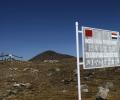
Two women from Arunachal Pradesh, January Tali and Hachu Lombo, have successfully scaled the 7,077-metre high Mt Kun in Ladakh, a challenging peak in the Zanskar range. Their achievement has been lauded by the Arunachal Pradesh Governor and is expected to inspire youth in the state.

Over 900 workers and employees are missing from various hydropower project sites in Nepal following massive flash floods triggered by an ice and rock collapse near the Nepal-Tibet border. Rescue teams, assisted by experts from India and China, are intensifying efforts to locate and extract hundreds believed to be trapped inside tunnels, with 279 already rescued amidst ongoing challenges.

Experts from the International Centre for Integrated Mountain Development (ICIMOD) suggest that an ice-rock avalanche originating in a high-altitude area likely triggered the devastating flash floods that swept across central Nepal districts, killing at least 95 people and leaving nearly 500 missing.

According to a report in The Telegraph, Chewang Norphel, 76, has said that he "built" 12 new glaciers already and is racing to create five more before he dies.

Glaciers in the Karakoram region are in a stable condition, but those feeding the Ganga and the Brahmaputra river basins are melting at a faster rate, the earth sciences ministry has said.
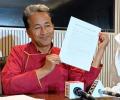
Wangchuk rued that over the years, glacial ice has been receding but action remains delayed.
With contentions over important dates like the melting of the Himalayas being disputed, the scientific studies, which contradict each other are losing credibility.

With all the criticism over the mistake, the IPCC has decided to bring in editors and coordinating lead authors for its fifth assessment report.

The main focus of the all weather RISAT-1B satellite will be to observe the Indian land with its C-band synthetic aperture radar.
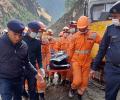
'Events like the one we saw on Sunday are complex geological processes which can be impacted by weather and climatic conditions.' 'It is difficult to attribute something like this to just one factor or to a particular time period, especially when we have still not understood the exact cause.'
